Hebrew Alphabet Chart for Kids: All 22 Letters with Sounds
The Hebrew alphabet is often called the aleph bet, after its first two letters. It has 22 letters, and it is read and written from right to left. There are no separate capital letters, so each letter has just one main shape to learn.
Hebrew letters are mostly consonants. The vowel sounds are shown with small dots and lines, called nikud, placed below or above the letters. That makes the alphabet a friendly place to start: learn the 22 letters first, then add the vowels.
This page gives you a complete Hebrew alphabet chart with each letter's name, sound and an example word. It works well for the Hebrew alphabet for kids at home, in Hebrew school or in Sunday school.
The Hebrew Alphabet Chart
| Letter | Name | Sound | Example word | Meaning |
|---|---|---|---|---|
| א | Alef | Silent; carries a vowel | ארנב arnav | rabbit |
| ב | Bet / Vet | b (with dot בּ) / v | בית bayit | house |
| ג | Gimel | g as in "go" | גמל gamal | camel |
| ד | Dalet | d | דלת delet | door |
| ה | Hey | h (often silent at the end of a word) | הורים horim | parents |
| ו | Vav | v (also used for the vowels o and u) | ורד vered | rose |
| ז | Zayin | z | זית zayit | olive |
| ח | Chet | ch as in "Bach" (throaty) | חתול chatul | cat |
| ט | Tet | t | טלפון telefon | telephone |
| י | Yod | y (also used for the vowel i) | ילד yeled | boy |
| כ | Kaf / Chaf | k (with dot כּ) / ch as in "Bach"; final form ך | כדור kadur | ball |
| ל | Lamed | l | לב lev | heart |
| מ | Mem | m; final form ם | מפתח mafteach | key |
| נ | Nun | n; final form ן | נהר nahar | river |
| ס | Samech | s | סבון sabon | soap |
| ע | Ayin | Silent in Modern Hebrew; carries a vowel | עץ etz | tree |
| פ | Pey / Fey | p (with dot פּ) / f; final form ף | פרי pri | fruit |
| צ | Tsadi | ts as in "cats"; final form ץ | צב tsav | turtle |
| ק | Kuf | k | קפה kafe | coffee |
| ר | Resh | r (from the throat in Modern Hebrew) | רופא rofe | doctor |
| ש | Shin / Sin | sh (dot on the right שׁ) / s (dot on the left שׂ) | שמש shemesh | sun |
| ת | Tav | t | תפוז tapuz | orange |
These are the same Hebrew letters children will meet in a siddur or in the Torah, so this chart is just as useful for biblical Hebrew for kids. The sounds above follow Modern Hebrew pronunciation.
How to Use This Chart
Twenty-two letters is a lot to take in at once. Go slowly and keep sessions short.
- One or two letters at a time. Pick a letter, point to it and look at its shape together.
- Say the name, then the sound. "This is Lamed. Lamed says l." The name and the sound are different, and children need both.
- Find it in a word. Look at the example word and spot the letter. Remember that Hebrew starts on the right.
- Review before adding more. Go back over earlier letters before moving on.
For a gentle week-by-week plan, read our guide on how to teach your child the Hebrew alphabet.
The 5 Final Letters (Sofit)
Five Hebrew letters change shape when they come at the end of a word. These are called final letters, or sofit forms. The sound stays the same; only the shape changes.
- כ becomes ך (final Chaf)
- מ becomes ם (final Mem)
- נ becomes ן (final Nun)
- פ becomes ף (final Fey)
- צ becomes ץ (final Tsadi)
You can see one in the chart: עץ (etz, tree) ends with a final Tsadi. Most final forms have a long stroke that reaches below the line, which helps kids spot them.
Letters with a Dot (Dagesh)
Three letters can make two different sounds. A dot inside the letter, called a dagesh, tells you which one to say.
- Bet / Vet: בּ says b, ב says v.
- Kaf / Chaf: כּ says k, כ says ch.
- Pey / Fey: פּ says p, פ says f.
A simple way to remember it: the dot makes a harder, "stopped" sound. Shin and Sin work in a similar way, but their dot sits on top: on the right for sh, on the left for s.
Look-Alike Letters Kids Mix Up
Several Hebrew letters look very similar. Point out the one small detail that makes each letter different.
- ב / כ: Bet has a little tail at the bottom right, like a foot. Kaf is rounded with no tail.
- ד / ר: Dalet has a sharp corner that sticks out at the top right. Resh is smooth and rounded.
- ה / ח / ת: Hey has a gap at the top left. Chet is closed on top. Tav has a little foot at the bottom left.
- ו / ז / ן: Vav is a short line with a small head. Zayin has a wider head stroke on top. Final Nun is long and reaches below the line.
- ס / ם: Samech is round and closed. Final Mem is square, and it only appears at the end of a word.
- ע / צ: Tsadi sits on a flat bottom line. Ayin has no flat base; its long stroke slants down to the left.
Quick Games to Practice with the Chart
Letter hunt
Call out a letter name and ask your child to find it on the chart. Then look for the same letter on a book cover, a card or a page of Hebrew text.
Flashcard memory
Write a few letters on small cards, twice each. Place them face down and take turns flipping two at a time. Say the letter's name and sound every time you find a pair.
Sound it out
Say a sound, such as sh or m, and have your child point to the letter that makes it. Switch roles so your child gives the sound and you find the letter.
Trace in the air
Draw a big letter in the air with one finger while saying its name. Then try it on your child's back or palm and see if they can guess which letter it was.
Next Step: Vowels and Writing Practice
Once your child knows most of the letters, the next step is the vowels (nikud). Adding a vowel mark to a letter turns it into a sound you can read aloud, and that is where reading begins.
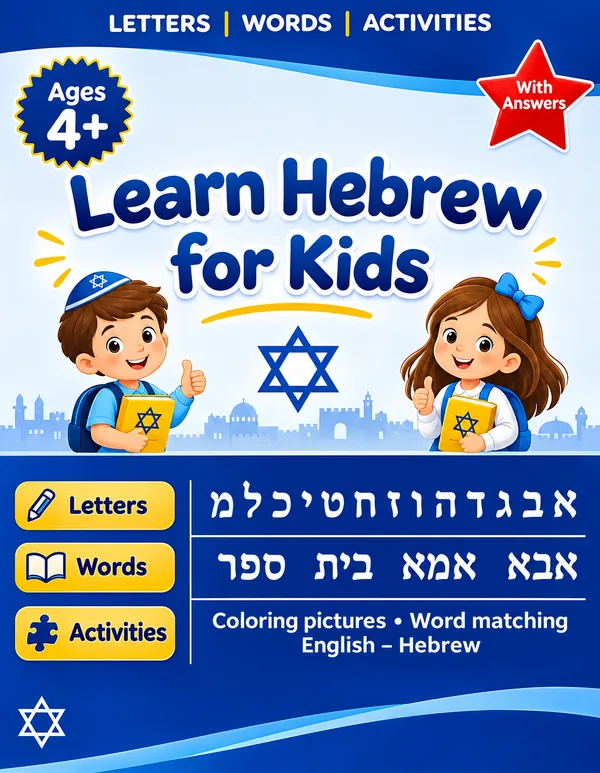
Writing helps too. Hebrew letters tracing builds memory for each shape through the hand as well as the eyes. You can trace every letter in Learn Hebrew for Kids, an 84-page workbook that covers the vowels, then goes through each letter one page at a time, with tracing rows for handwritten letters and space to write your own.
Most of the example words in the chart above come from the same workbook, where each word appears with its transliteration, English meaning and a picture to color. Want to try a few pages first? Get free sample pages by email.